

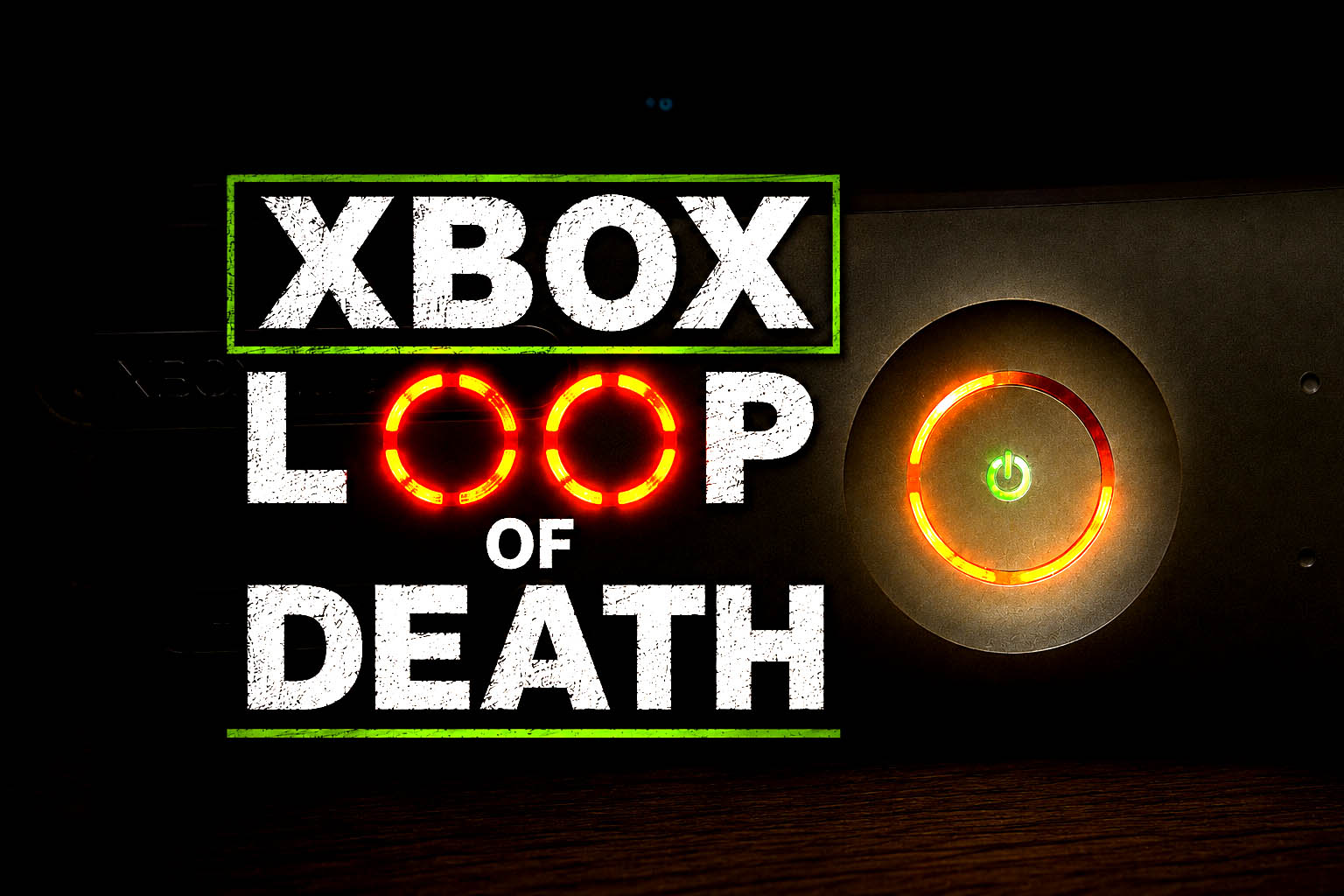
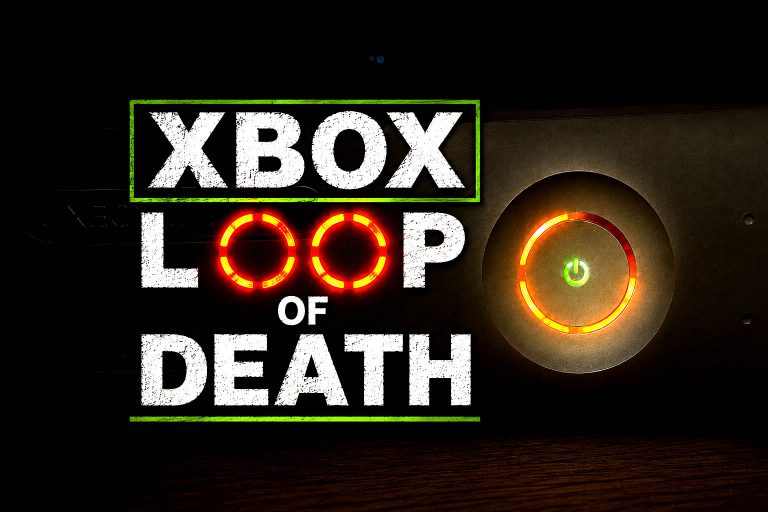
XBOX’s Loop of Death
The company’s latest reset is not some minor adjustment. In July 2026, Microsoft announced roughly 4,800 layoffs across the company, including 1,600 Xbox employees immediately, with another 1,600 Xbox positions expected to disappear during the fiscal year.
Xbox is also giving up control of several studios, including Double Fine and Compulsion Games, while Ninja Theory and Undead Labs are being put up for sale. Microsoft is effectively cutting roughly 20 percent of Xbox’s workforce.
And what is the answer?
Again.
That is the part that should make every Xbox player furious, because Microsoft appears determined to treat the symptoms while refusing to confront the culture and priorities that helped create the mess.
This is what we call the loop of death:
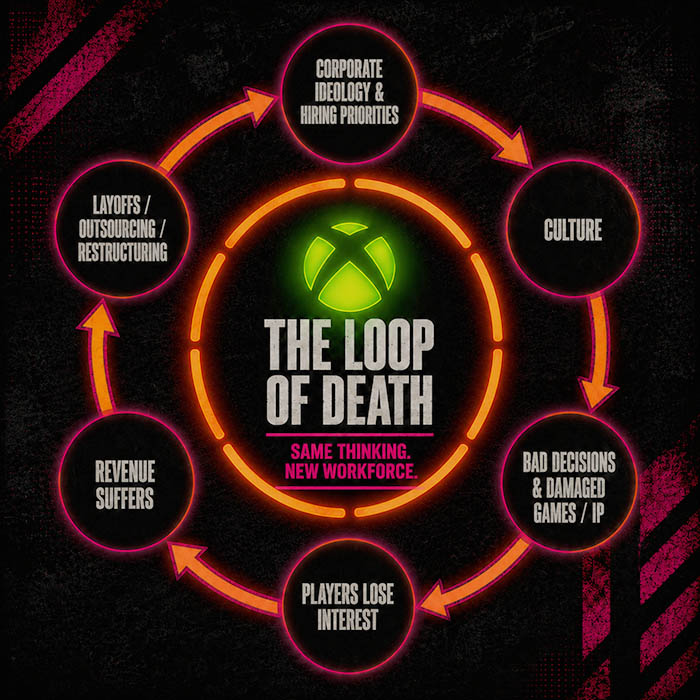
It is running around inside it.
Xbox Didn’t Become Broken Overnight
Let’s be clear about something: Microsoft has every right to restructure a business that isn’t performing. What it does not have is the right to pretend that repeatedly moving people around the organizational chart constitutes a solution.
Xbox has spent years expanding aggressively. Microsoft paid approximately $69 billion for Activision Blizzard. It acquired Bethesda and ZeniMax for $7.5 billion. It built one of the largest first-party portfolios in the industry and spent years selling Game Pass as the future of Xbox.
You don’t spend billions building an empire just to start selling off the pieces unless something has gone seriously wrong.
The numbers are particularly ugly when placed alongside Microsoft’s own explanation. Xbox CEO Asha Sharma said the business had been operating at margins dramatically below comparable platform and publishing businesses, while the latest reset is intended to address a gaming operation that Microsoft considers unhealthy.
Fine.
Asha Sharma is a corporate productivity executive running a gaming company. Ater overseeing thousands of Xbox layoffs, she was appointed to the Federal Reserve’s Productivity and Jobs Task Force
Maybe she belongs in a boardroom or a financial lobbying office. She sure as hell doesn’t belong anywhere near the gaming industry.
Because this is where the industry’s favorite trick comes in: when the strategy fails, blame the developers.
The corporate machine rarely asks whether it hired the wrong people, rewarded the wrong priorities, created the wrong culture or put the wrong people in charge of creative decisions. Instead, it announces that the business has to “transform,” “reset,” “streamline” or “realign.”
Maybe The Problem Is The Machine
This is where Player 1 refuses to play along.
Microsoft and Xbox have spent years making diversity and inclusion a bigger part of how their games are developed. That includes decisions about who gets represented, how characters and stories are presented, and what kinds of perspectives are prioritized. Those same priorities have also shaped the workforce itself, influencing how Microsoft approaches hiring and the people it brings into its studios. Xbox has formal guidelines around these priorities for its development teams.
We’re not going to pretend that every bad Xbox game can be reduced to a single DEI initiative. Reality is more complicated than that.
But the larger question is completely legitimate: what happens when corporate ideology and corporate hiring priorities become more important than raw creative ability?
Not corporate freaks. Game freaks.
The programmer who knows every obscure engine trick. The artist who has been drawing monsters since he was twelve. The designer who can spend an afternoon arguing about why Halo feels different from every other shooter. The obsessive who knows exactly why a combat system feels wrong even if he can’t put the explanation into a twelve-slide corporate presentation.
Those are the people we want making games.
Not because they fit a demographic chart. Not because they know how to repeat the correct corporate language. Not because somebody in HR can point to them and announce that the company has achieved another diversity milestone.
And when Xbox’s strategy produces disappointing games, damaged franchises, bloated productions and enormous financial losses, the answer shouldn’t automatically be to fire more people.
Maybe Microsoft needs to stop trying to build the perfect corporate employee and start building the best damn game-development team it can find.
And Then Microsoft Fires The Workforce While Building Another One
And then there is Microsoft’s H-1B pipeline.
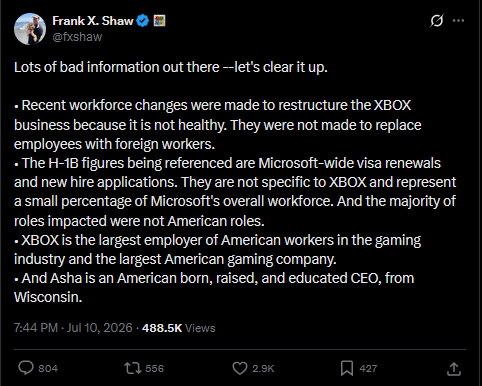
When Microsoft denies that foreign-worker hiring is connected to the Xbox layoffs, we’re happy to put the denial on the record. But we’re also going to put the numbers next to it.
Over a ten-year period Microsoft filed 53,454 Labor Condition Applications for H-1B, H-1B1 and E-3 workers between 2016 and 2025. The yearly figures are striking: 1,461 in 2016, 4,946 in 2017, 5,918 in 2018, 3,911 in 2019, 1,252 in 2020, 6,077 in 2021, 1,837 in 2022, 7,616 in 2023, 10,564 in 2024 and 8,047 in 2025. Almost all were certified. The data comes from Department of Labor disclosure records.
Now put that next to the layoffs.
Microsoft was cutting thousands of workers while continuing to file thousands of applications for foreign workers.
That is the fucking story.
Microsoft can say the H-1B workers aren’t specifically “Xbox workers.” Fine. The broader corporate labor model is still staring us directly in the face: lay off thousands, outsource more work, restructure the organization and continue bringing in foreign labor through a visa system that Microsoft itself uses at enormous scale.
And we’re supposed to believe the obvious question is somehow off limits?
We are going to ask why Microsoft is so willing to tear apart the workforce it already has while continuing to build another one.
Because this is exactly where the hire-the-nerds argument matters.
We don’t want Xbox searching for the cheapest workforce it can assemble. We want Xbox searching for the best game developers it can find: the obsessive programmers, artists, designers and engineers who grew up loving these games and understand their craft down to the bone.
Build teams around talent, obsession and competence. Bring back the game nerds. Stop treating development like interchangeable labor that can simply be moved from one spreadsheet column to another.
Microsoft spent billions buying studios because it supposedly wanted the greatest gaming portfolio in the world.
Now it is cutting the people inside that portfolio while maintaining a global labor pipeline and expanding outsourcing.
We are attacking Microsoft’s decision to reach for this labor model while repeatedly cutting the developers that built its gaming business.
It didn’t fix the culture.
that made these franchises matter.
It outsourced.
It restructured.
And then it went looking for another workforce.
LOOP OF DEATH.
And if Microsoft runs it again, it won’t be the executives who ultimately decide whether Xbox survives.
It will be the players.
Because they are the ones with the only vote that matters.
About the Author





Just testing anon comment